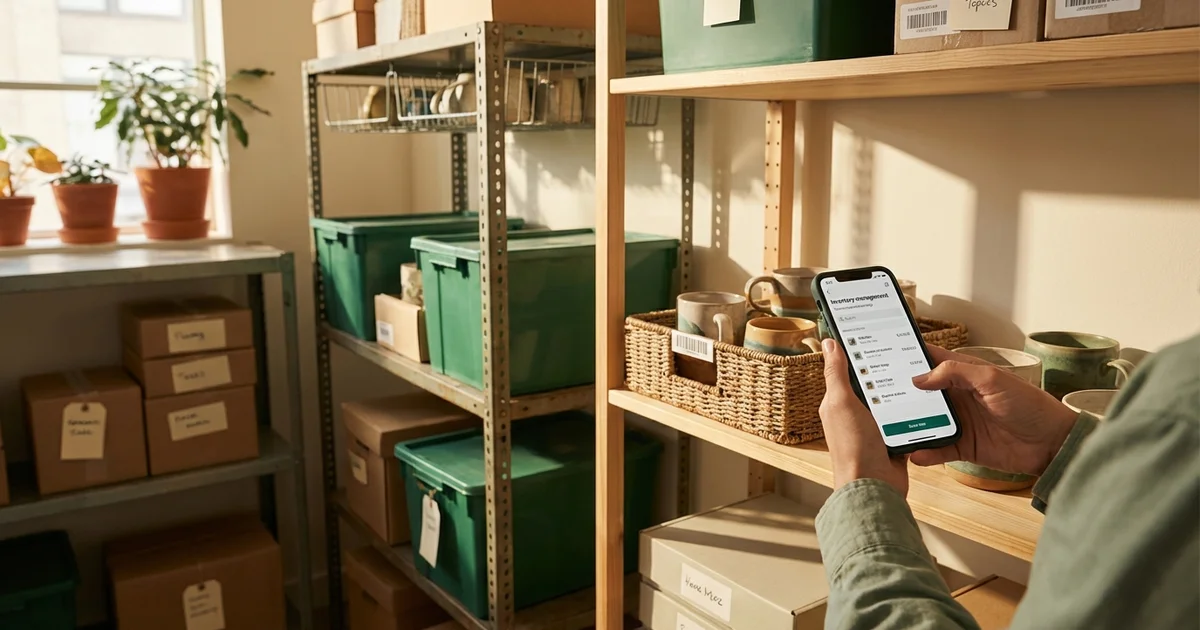
Small Business Storage Hacks: Turn Your Back Room into a Smart Mini Warehouse
Transform your chaotic back room into an efficient mini warehouse. Learn smart storage zones and simple digital tracking for small business inventory.
Transform Your Back Room Into a Mini Warehouse: Smart Storage Solutions for Small Business
Sarah's customer was getting impatient. The boutique owner had promised to retrieve a special-order handbag from the back room "in just a moment"—but that moment had stretched into ten minutes of increasingly frantic searching.
Somewhere in the maze of unlabeled boxes, overstuffed shelves, and last season's inventory that "might still sell," Sarah's $400 sale was waiting to be found. Meanwhile, her customer was checking her watch, and two other shoppers had left without assistance.
When Sarah finally emerged—flushed, apologetic, and empty-handed—the customer walked out too.
Sound familiar? If you've ever lost a sale because your back room swallowed your inventory, or spent your morning hunting for items you *know* you ordered, you're not alone. The question isn't whether your storage system is costing you money—it's how much.
The Hidden Costs of Chaotic Storage
Most small business owners accept back room chaos as an unavoidable reality. "It's just how small retail works," they tell themselves while stepping over boxes to reach a shelf they can barely see.
But here's the uncomfortable truth: that chaos has a price tag.
The Numbers Don't Lie
Industry research suggests that disorganized inventory costs small businesses an average of 8% of their annual revenue through lost items, duplicate orders, and missed sales. For a business generating $200,000 annually, that's $16,000 walking out the door—or rather, staying lost in the back room.
Beyond the financial hit, there's the daily time drain. Employees in poorly organized stockrooms spend an average of 20+ minutes per day simply *looking* for things. Over a year, that's nearly two full work weeks spent on treasure hunts instead of serving customers.
The Ripple Effect
When customers have to wait while you search for items, their perception of your business shifts. That "charming small shop" suddenly feels unprofessional. The trust that brings customers back erodes with every "Let me check in the back" that takes too long.
The good news? This is entirely fixable—and you don't need expensive warehouse software or a complete renovation to do it.
Smart Storage Zones: The Mini Warehouse Approach
Professional warehouses don't succeed by accident. They operate on systems designed for speed and accuracy. The secret isn't complexity—it's intentional organization.
You can apply the same principles to your back room, regardless of size.
The Three-Zone System
Fast-Access Zone: This is your prime real estate—the space you can reach without moving anything else. Reserve it exclusively for items you access daily or multiple times per day. Think of it as your "grab and go" area. Organize by frequency of use, not by category or vendor.
Bulk Storage Zone: Seasonal inventory, backup stock, and items you need weekly rather than daily belong here. The key is clear sightlines and labels visible from a standing position. You should never have to move Box A to read what's in Box B.
Receiving Zone: This is where new shipments live *temporarily* while being processed. Without a dedicated receiving zone, new inventory disappears into the chaos before anyone logs it. Even a small table or designated floor space makes a difference.
Why Zones Work
Zoning transforms your behavior from reactive to proactive. Instead of frantically searching everywhere, you know exactly where to look based on what you need. Your brain builds a mental map, and retrieving items becomes almost automatic.
But zones alone aren't enough. The real magic happens when you add a digital layer.
The Digital Layer: Tracking Without Complexity
Traditional inventory management software was designed for large operations with dedicated IT staff. For small businesses, these systems often create more problems than they solve—steep learning curves, expensive subscriptions, and features you'll never use.
What small businesses actually need is simple: know what you have and know where it is.
Visual Inventory: See Before You Search
The human brain processes images 60,000 times faster than text. That's why photo-based inventory tracking is transforming how small businesses manage their back rooms.
Instead of spreadsheets listing "Blue Widget, Shelf 3, Bin B," imagine pulling up your phone and *seeing* exactly what's in that bin. No guessing, no misremembering, no confusion between the "navy" blue and the "royal" blue.
Location Coding Made Simple
You don't need barcode scanners or RFID tags. A simple location system—Zone A, Shelf 2, Bin 3—combined with photos creates a searchable map of your entire inventory.
Apps like Squared Away make this process remarkably straightforward. You photograph items, tag their locations, and suddenly your entire back room becomes searchable from your phone. When a customer asks about a product, you can check availability and exact location without leaving the sales floor.
Mobile-First Updates
The best inventory system is one you'll actually use. If updating your inventory requires walking to a computer, logging in, and navigating complex software, it won't happen consistently.
Mobile-first inventory tracking changes the equation. Standing in your receiving zone unpacking a shipment? Photograph items and log them in real-time. Sold the last of a product? Update your inventory before you even finish the transaction.
Squared Away was built specifically with this workflow in mind—making inventory updates as quick and natural as sending a text message.
Your 48-Hour Transformation Plan
You don't need a week to overhaul your back room. With focused effort over two days, you can create a system that serves you for years.
Day 1: Clear and Zone
Morning (2-3 hours):
- Remove everything from your back room
- Sort into three piles: Keep & Organize, Sell/Donate, Discard
- Be ruthless—if you haven't sold it in a year, it's costing you shelf space
Afternoon (2-3 hours):
- Designate your three zones based on your room's layout
- Position your Fast-Access Zone closest to the door
- Install any additional shelving or bins needed
- Return items to their designated zones
Day 2: Digitize and Document
Morning (2 hours):
- Photograph your most critical inventory (bestsellers, special orders, high-value items)
- Log locations using your zone system
- Using an app like Squared Away, create searchable entries with photos and location tags
Afternoon (1 hour):
- Test your system by having someone else locate items using only your digital records
- Adjust labels and locations based on what's confusing
- Create a simple daily maintenance checklist
The 10-Minute Daily Habit
Systems fail when maintenance feels burdensome. Protect your investment with a simple daily routine:
- 2 minutes: Process the receiving zone (photograph and log new items)
- 3 minutes: Update any inventory changes from the day's sales
- 5 minutes: Quick visual scan to ensure items are in their designated spots
That's it. Ten minutes daily keeps your mini warehouse running like a professional operation.
Take Control of Your Back Room
Sarah's story doesn't have to be yours. The difference between a back room that costs you money and one that makes your business more efficient isn't size, budget, or special equipment—it's intention.
Smart zones create predictable organization. Digital tracking creates instant accessibility. Together, they transform your storage from a liability into an asset.
Your back room can work *for* you instead of against you. The tools exist. The system is proven. The only question is whether you're ready to stop accepting chaos as normal.
---
Ready to transform your back room from chaos to control? Try Squared Away free and see how easy professional inventory tracking can be. With photo-based documentation and intuitive location tracking, you'll wonder how you ever managed without it.
Get Started with Squared Away →
---